
Medigap Shopping Mistakes to Avoid (Reddit Advice Breakdown)
Today, I’m going to do something a little bit different. I’m going to go on Reddit and find one of the most popularly discussed topics around shopping for Medigap (Medicare Supplement) insurance.
I’ll go through individual recommendations people are promoting online to help other consumers shop for Medicare Supplement insurance, using these sets of questions or topics to guide their Medicare Supplement shopping.
My name is Mark Prip, and I’ve been helping people understand Medicare for over 15 years. I’ve heard a lot, and I’ve seen a lot. And you think Medicare is confusing? I’ll show you a few reasons why it’s getting even worse when you go online and try to understand how to compare plans – and which plan to pick.
So my advice for today is, understand where you’re getting your information. This process is a lot simpler than you think. Don’t overwhelm yourself with all of the places that you are trying to retrieve data and information to make the decision.
I’ll show you how not to become paralyzed by analyzing (better known as paralysis by analysis).
Is the Plan Competitively Priced?
Let’s jump right into this topic that everyone is talking about. I pulled out my laptop and went to Reddit – and I’m going to cover the subcategories of this post.
An individual on Reddit posted this:
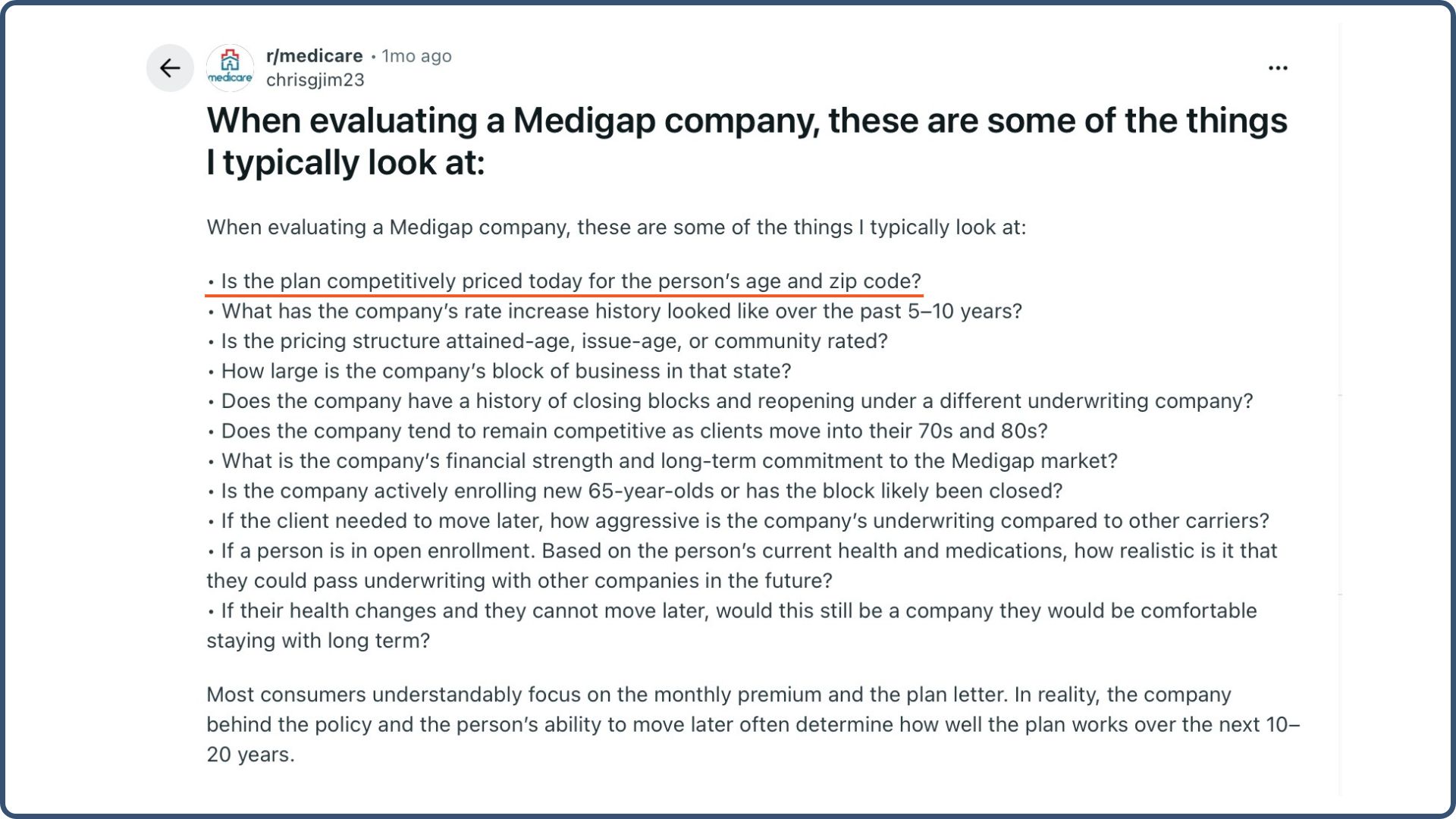
“When evaluating a Medigap company, these are some of the things I typically look at.”
The first question is, “Is the plan competitively priced today for the person’s age and zip code?”
Great point. That is very important. Is the plan competitively priced based on your location?
Medicare Supplement (Medigap) plans are standardized in terms of coverage, but the monthly premium can differ significantly depending on where you live and how old you are. Two people enrolling in the exact same Plan G could be paying completely different premiums simply because they’re in different ZIP codes or enrolling at different ages.
So yes – making sure a plan is competitively priced in your area is important. You don’t want to overpay for identical coverage.
What Has The Company's Rate Increase Looked Like?
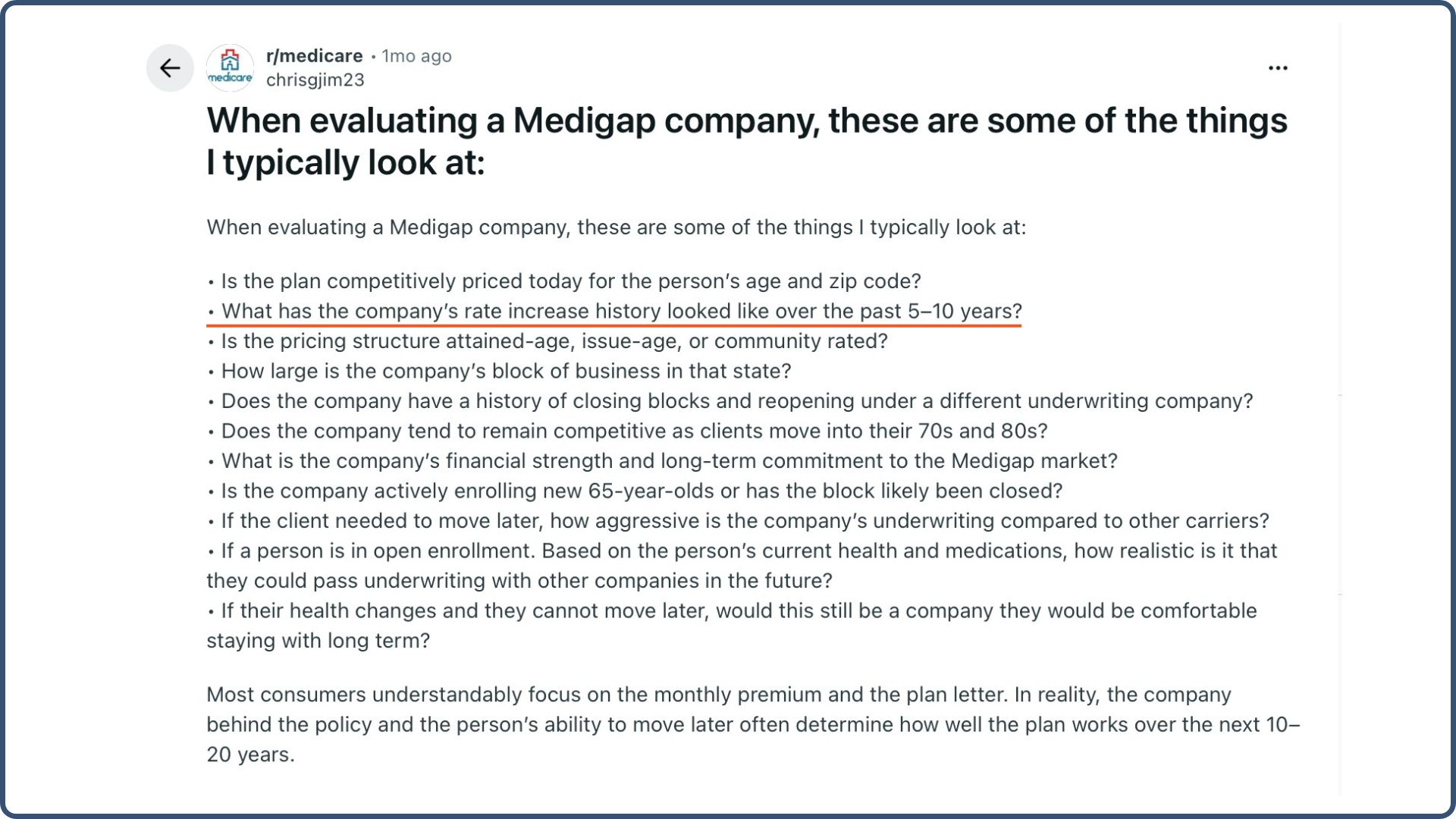
The second topic is:
“What has the company’s rate increase history looked like over the last 5 or 10 years?”
Now, this used to be an important talking point, but it completely got washed out the window (or flushed down the toilet) in 2025. We used to be able to confidently say that rate increases were around 5 or 7% per year. Pretty predictable.
In 2025, we saw rate increases as high as 40% in the state of Illinois, 25% throughout the country, and in other areas. So, when you’re doing your research and asking about the last 5 or 10 years, it’s pointless. It does not matter because nobody can give you this information. No agent, no broker, no company.
The only people who have access to what rates look like – or could potentially look like – are the actual insurance company’s actuarial department. As claims come through and premiums come in, how much premium comes in versus how much goes out in claims, is going to predict rate increases.
That was fairly stable through the years, but in the last year or two, that has shifted significantly. And that’s not just in the Medicare Supplement market, that’s in the group health insurance market and the Obamacare market too. 2025 saw the largest rate increases across all segments of health insurance.
I’m not saying it’s not important. I’m encouraging you not to obsess about that, because nobody is going to give you concrete information about which company to pick that looks the best based on the last 5 or 10 years. 2025 completely smashed that research trend.
At the end of this page, I’ll give you some tips and pointers on how to do your best, and what things you should be focused on.
Is the Pricing Structure Attained-Age, Issue-Age, Or Community Rated?
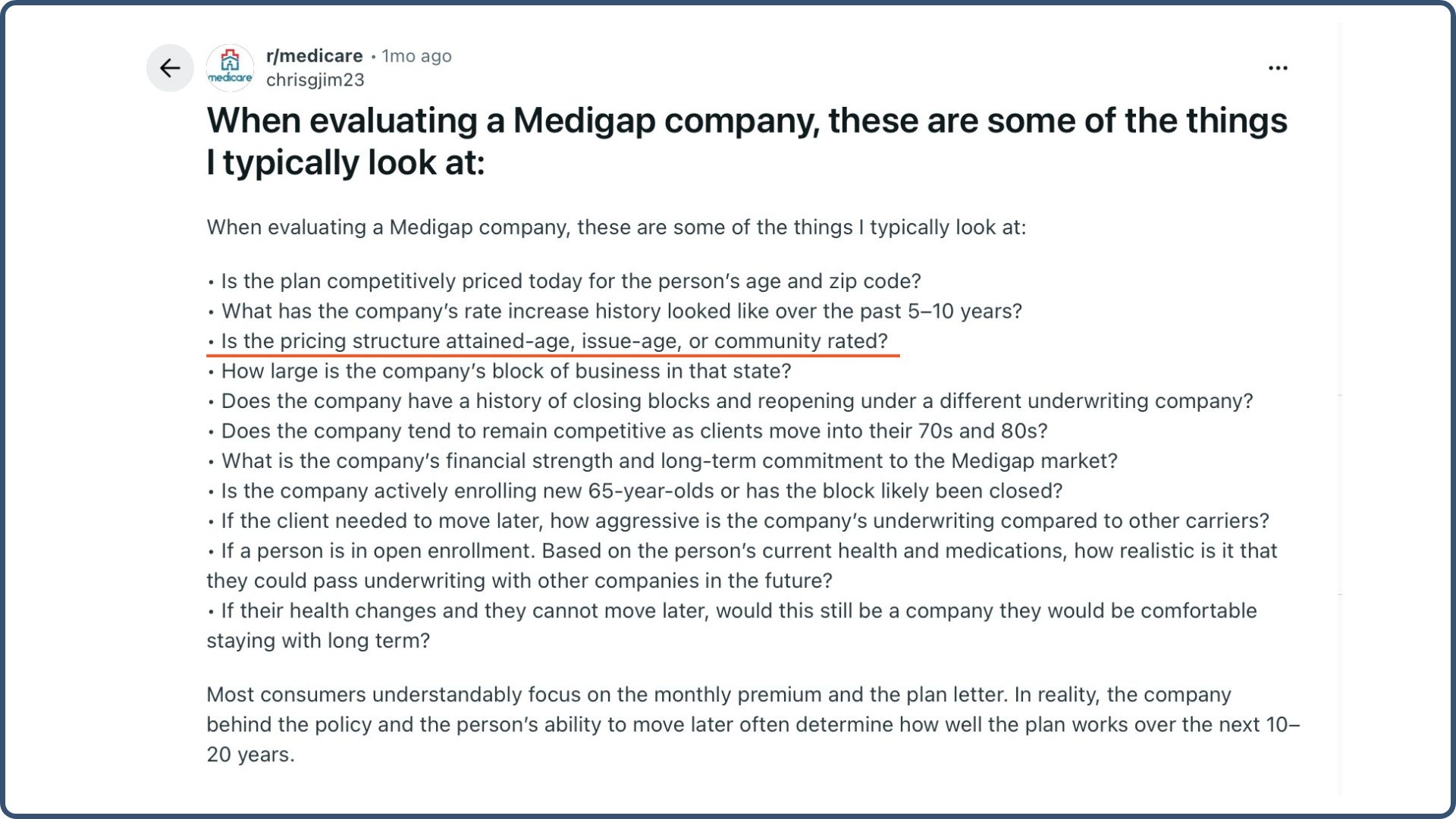
Let’s move on to the next question:
“Is the pricing structure attained-age, issue-age, or community rated?”
Depending on your state and the company, you can find that out. But let’s simplify what this actually means, because this is where people often start to feel overwhelmed.
There are three main ways Medigap plans are priced:
- Attained-age rated: Your premium starts lower, but increases as you get older.
- Issue-age rated: Your premium is based on your age at enrollment and doesn’t increase with age (though it can still go up due to inflation or other factors).
- Community-rated: Everyone pays the same premium regardless of age.
On paper, this seems like a really important distinction – and it is to a degree. But here’s where I’ll push back a little bit – because a lot of people get stuck trying to figure out which pricing structure is “best,” when in reality, it’s not as predictive as you might think.
Regardless of the pricing method, rate increases can and do happen across all three types. An issue-age plan isn’t immune to increases. A community-rated plan doesn’t mean your premium will stay flat forever. And an attained-age plan isn’t automatically a bad choice either. It’s also worth noting that the choice of pricing structure is often not up to you; many times, it is determined by state regulations, and insurance companies must comply with those standards.
How Large Is the Company's Block Of Business in That State?
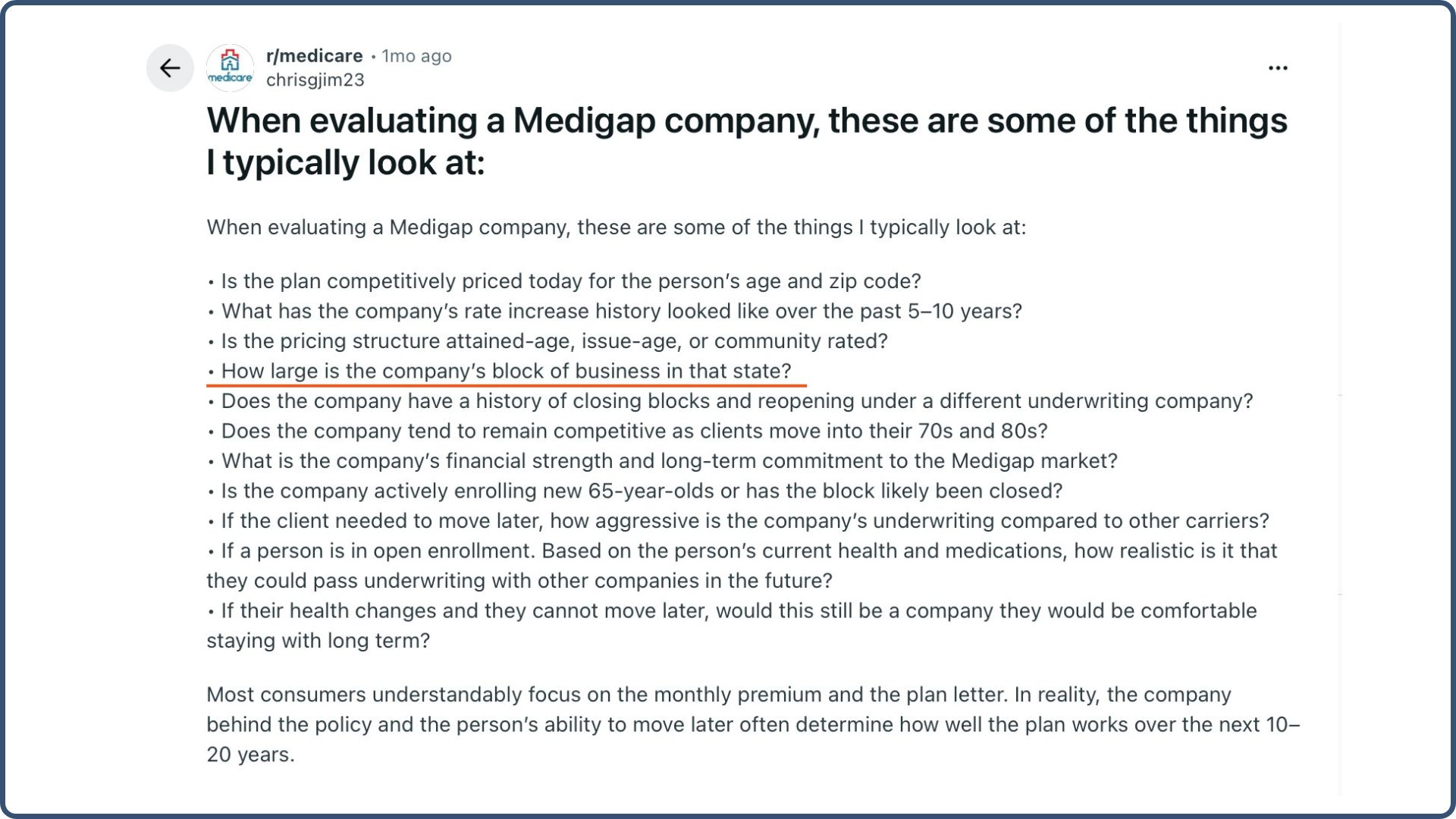
Moving on to the next question:
“How large is the company’s block of business in that state?”
Imagine this: before selecting a homeowner’s and car insurance plan from a reputable company, what if you called these companies to ask how many cars they insure in the state and how many homes they cover? This information likely wouldn’t provide enough insight to influence your decision; it’s more of a trivial detail.
It’s important to clarify the term “reputable.” As we will discuss further, this doesn’t mean that the size of the company isn’t significant. A better distinction to consider is based on each company’s time in the market, along with its history and stability.
Closing and Reopening Under a Different Underwriting Company
“Does the company have a history of closing blocks and reopening under a different underwriting company?”
You will not avoid that. All big national companies do that – there’s no way around it. Some companies that won’t are your regional carriers or state-based carriers like Blue Cross Blue Shield, which is an association. Every state operates independently.
For example, Blue Cross Blue Shield of Texas or Blue Cross Blue Shield of Florida (now known as Florida Blue) has one block of business for one state for its residents. Those don’t tend to change because they don’t have the buying power or organizational structure to launch or retire a brand.
What you’ll find is that these big-company rates are always lower. When we work with clients, we’ll often compare Blue Cross and then usually UnitedHealthcare, Cigna (HealthSpring), Mutual of Omaha, and Aetna. We’ll always compare the big household names.
And 9 times out of 10, I can’t even give you an example where Blue Cross is cheaper. They’re always more expensive because they don’t handle the block opening and closing, but they start higher. The national carriers like Aetna or Healthspring, which open and close blocks, are way more competitive to start with than most of Blue Cross.
There is no way to understand future rate increases amongst any carriers. None. The only way that you would know that information is, let’s say you’re on a plan and the block or the book has 100,000 people. Nobody knows the risk level for 100,000 people at any given time, in any block of business, with any carrier, in any state.
It matters to a degree, but it’s out of your control. Don’t spend your time talking about businesses closing and opening a block of business. It won’t affect you, and there’s nothing you can do about it.

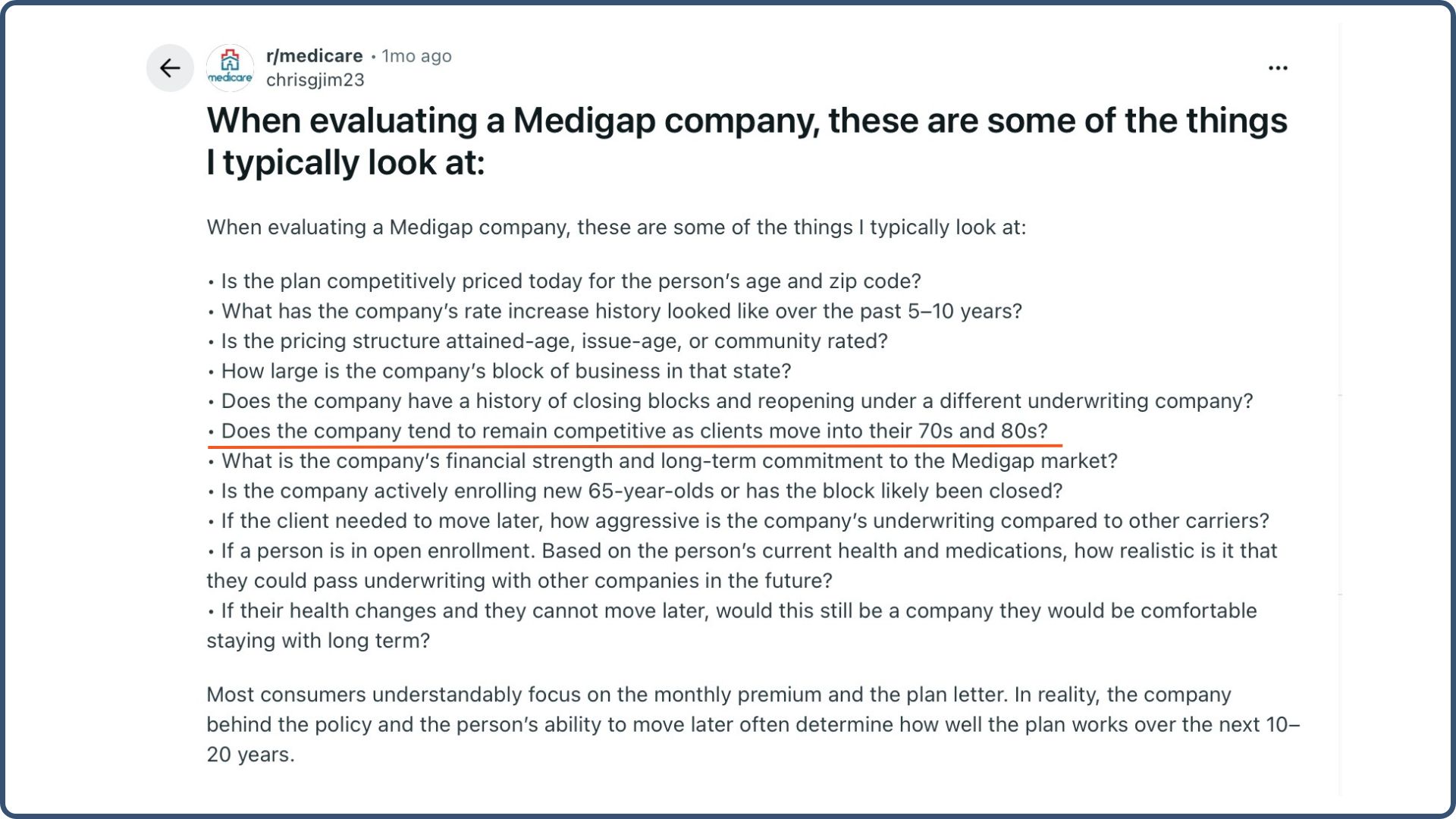
Does the Company Tend to Maintain Competitive Rates?
Does the company tend to maintain competitive rates as clients move into their 70s and 80s?”
That’s ludicrous. How is a company going to know what its rates will be a year from now, two years from now… let alone 10, 15, or maybe even 20 years from now?
Don’t bog yourself down with that type of question or spend time trying to research it. You can’t control that. The company doesn’t know. All it’s doing is fogging your brain and making you more stressed out.
What Is the Company's Financial Strength and Long-Term Commitment to the Medigap Market?
Moving on.
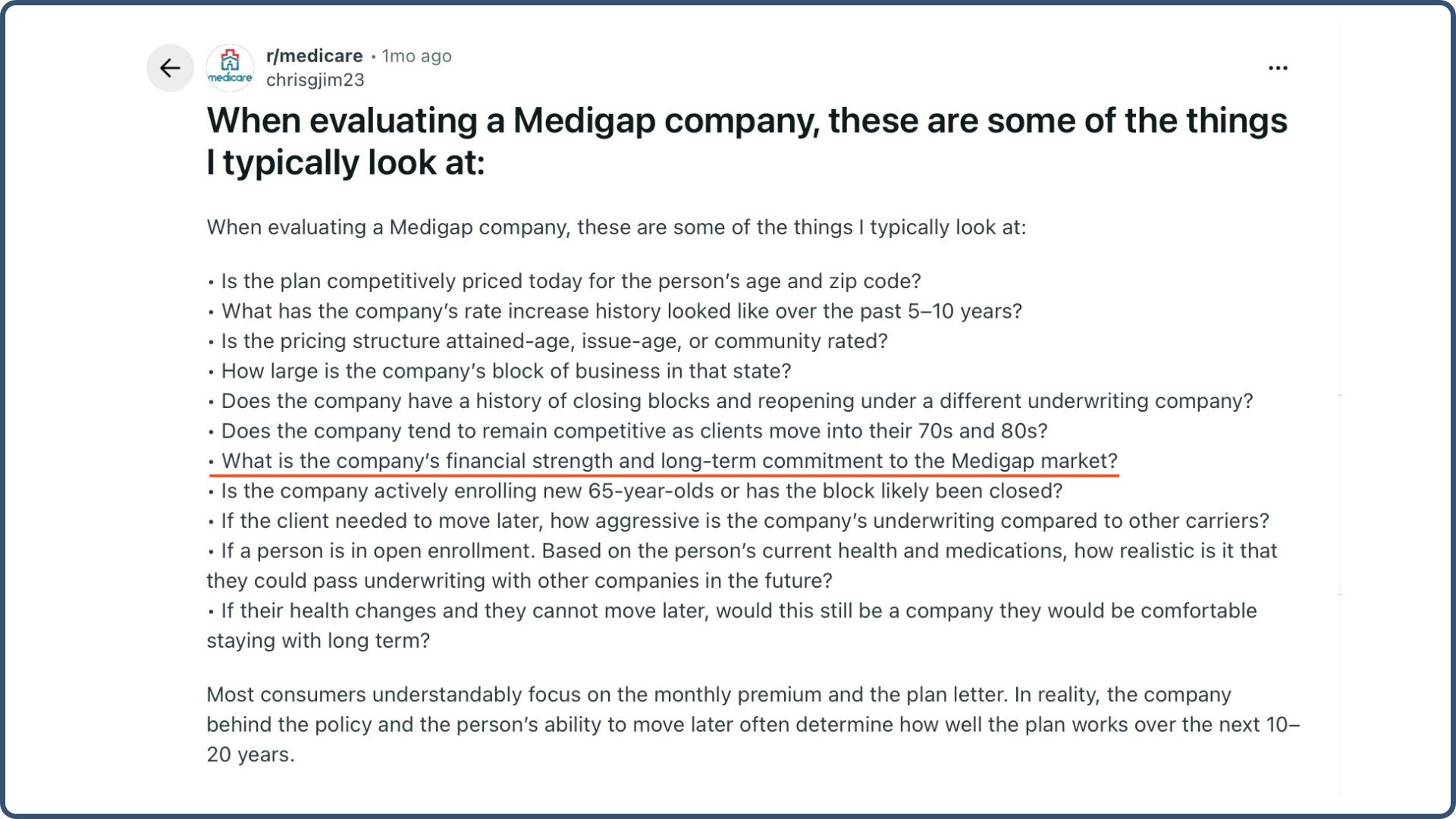
“What is the company’s financial strength and long-term commitment to the Medigap market?”
I believe that is very important. A few years ago, we saw companies like Allstate enter the Medigap market. Very low premiums, very competitive. Well, guess what happened in 2025, mid-year? They closed the block of business, so they would not take any new membership, period. They didn’t rebrand.
Similarly, ACE initially launched strongly under the CHUBB umbrella with competitive pricing. A year later, they began to close that block of business and have since removed it from most states. They are relaunching as INA.
My point is that longevity in the market does matter. We have a rule in our office now: after what we saw with ACE and Allstate, we will not recommend a company to any client unless they’ve been in the Medigap market for at least 5 years.
Because these companies are entering the market as the baby boomer rush floods the Medicare system, they want a piece of the pie, but they can’t sustain it. These brand-new small companies try to come in and undercut big companies like UnitedHealthcare and Mutual of Omaha.
Their premiums may be lower to start, but they can’t maintain the claims ratio to premiums that are coming in. You can’t come into a market and be the cheapest on the block and expect to be smarter and more efficient than a gorilla in the room like UnitedHealthcare. It’ll never happen.
Is the Company Actively Enrolling New 65-Year-Olds?
“Is the company actively enrolling new 65-year-olds, or has the block likely been closed?”
That doesn’t really matter. If a block of business is closed, you’re never even going to encounter that company when you’re shopping for a plan. They’re not marketing, they’re not taking applications, and you’re not going to see their rates when you compare options.
So from a practical standpoint, it’s not something you need to spend time researching or worrying about. This is another example of a question that sounds important on the surface, but doesn’t actually impact your decision when you’re in the process of enrolling.
You’ll only be presented with companies that are actively accepting new members. Those are the options in front of you – and those are the ones worth comparing. Anything outside of that just adds unnecessary noise to the process.
So again, don’t overthink it. If a company isn’t open for new enrollment, it’s simply not part of your decision.
How Strict Is the Company’s Underwriting if You Need to Switch Later?
“If the client needed to move later, how aggressive is the company’s underwriting compared to other carriers?”
I don’t know really why that matters, unless it means move plans. There are so many variables that go into moving from, say, a Plan G to a Plan N. It’s hard to predict that because it will be based on your age and your location.
Here’s a few questions you can research:
Are there any birthday rules that allow you to switch plans?
Does your state have an annual Open Enrollment Period that lets you move amongst carriers?
That would be what I would focus on is what your state-based rules are to allow you to switch Medigap companies anytime of the year, which is a national feature.
You don’t have to wait to switch Medigap companies to a specific Open Enrollment Period. But if you want to change from a G to an N or vice versa, after your initial enrollment period, you could face underwriting depending on your state.
Just be sure to understand the state rules that allow you to switch plans in the future, whether there’s underwriting required, or if you have a birthday rule or a guaranteed-issue window of some kind.

My Advice
That mostly concludes my Reddit ramble for today. My goal here was to help people simplify this process. This is an overwhelming amount of information for the average consumer to figure out.
The very first comment after these suggestions are made, someone posts, “Where would I find all of this information?” And you can’t. A vast majority of it does not exist. If you wanted to get really specific, you could call your state Department of Insurance and ask about past rate increases for a particular company, but that is a lot of recommendations where 75 or 80% of that is out of your control.
So what I would recommend is focus on this: if you’ve decided on a Medicare Supplement and you’ve ruled out Medicare Advantage (hopefully you’ve ruled out Medicare Advantage because Medicare Supplement is far superior), find the lowest cost Plan G or Plan N in your area, or a High Deductible Plan G if you want to save on monthly costs.
Pick a company that’s been in the market for over five years, a household brand name you’re familiar with, and find out which one is the most competitive.
One of the things that’s not listed here that’s very important is to find out if companies offer a household discount if you and your spouse both apply. Many national companies will say, “Here’s your premium, let’s say $150 a month, and if your spouse applies with you, or you live with someone over the age of 60 who qualifies as a caregiver, we’ll give you 5% or possibly 10% off.” Every company is different, and that varies by state, so ask about household discounts.
Beyond that, find a reputable brand with an affordable premium. Verify with your state what the rules are if you want to change later. That’s something we can help you with during a needs analysis. We can pull up your state rules and explain what you can and can’t do in the future.
Again, pick brands and names you’ve heard of and are familiar with. If you’ve never heard of the name and it’s significantly cheaper than every other company, that’s a red flag. You can enroll at that lower premium, but there’s a likelihood that block will increase more because the pool is small and new. It’s very immature. No new company is going to be smarter than companies that have been in the industry for 40, 50, or 60 years.
In terms of blocks of business, future rate increases, moving, and all of the other things you can’t get clear information on, don’t stress about it. Get on a plan. The most powerful thing about Medicare plan selection is that Medicare Supplement gives you the most control over your healthcare. There are no referrals, no networks, no prior authorizations, and no annual plan changes. You cannot lose the plan as long as you pay your premium.
If you’re comparing Medicare Supplement to Medicare Advantage, all of that is the opposite. Medicare Advantage has prior authorizations, benefits change every year, and the contract is only 12 months. Every Medicare Advantage plan renews with CMS annually, and there are many reasons why a company may not renew, often tied to profitability. If a company is not profitable in your county, they can terminate the plan and send you back to the market.
Yes, you may have a guaranteed-issue right, but that restarts the entire process. With a Medicare Supplement, you do not have those issues. As long as you pay your premium, you keep the plan for life, regardless of whether the company closes its block.
I hope this helps you shed some of the excess research and focus on the basics of what a Medigap plan is. If you have questions or would like to conduct a needs analysis, give us a call. We’d be happy to help. Take care.